Future of Mallorca Tourism: Optimism and Investment

In the European tourism world, there are three main tourist fairs. The World Travel Market in London in November, Fitur in Madrid in January and the ITB in Berlin in March. These are all large-scale events where exhibitors from travel, hospitality, and cultural sectors convene to showcase their services and products.

So the great and the good from the travel world here in Mallorca have returned from Madrid, and I was wondering what was the message they returned with. 

After speaking to a few of them, the main answer I got was “optimism”. 

One of the main problems the Government need to address is the sustainability of the Islands and how they are going to do that yet still reap the economic benefits.

President Marga Prohens announced that 1.12 billion euros is to be spent on tourism sustainability and modernisation in the Balearics.

The slogan for the campaign is ‘the reason is you’ and the strategy is to make the Balearics a benchmark in tourism sustainability. The money will come from the EU next generation funds and the tourist tax – respectively 260 million euros and 860 million euros of tourist tax revenue raised since 2016.

Being an island, we rely on people arriving by air and sea, so is it any wonder the amount of investment in our airport and ports?

Many airlines are increasing their seat capacities. One of them United Airlines from the United States, will increase its direct flights from Palma to New York by more than 50%. A route between the two cities that will also remain in operation until the 24th of October, an extra month on last year.

Anybody travelling through Palma Airport this winter will have seen the massive investment in the infrastructure. Now, I imagine this is being put in place to improve the customer journey, but without doubt it is also preparing for an increase in passenger numbers. 

Back in 2021 there was a 5-year agreement signed to limit the size and number of cruise ships visiting Palma. Whilst there are fewer ships and passengers compared to 2019, the numbers are still high. In 2025, 541 cruise ships are scheduled for Palma. The total number of passengers is put at 1.8 million. By comparison with 2024 there will be 47 more ships and 41,000 more passengers. 

According to Ibestat the passengers that disembark “only spend €35 on the island”. Only? That’s not a bad per head for a person spending less than a day here. That 63 million euros I am sure is welcome. What isn’t taken into account is the employment this all creates and the other revenue such as coaches, taxis and the companies restocking those ships. I would also wager a bet that a certain percentage of those 1.8 million visitors will return to the island for another holiday. 

You may wonder why the Club de Mar and the Paseo Maritimo in Palma are being revamped? Like the airport, I imagine this has been to not only improve the area for residents but preparing for greater numbers arriving at the port. 

1 in 5 people in the Balearics work in Tourism, we all know someone who is involved in that Industry. Tourism both directly and indirectly contributes between 40% and 50% of the Balearic Island’s total GDP. Mallorca continues to face major challenges in terms of making tourism more sustainable while at the same time safeguarding their economic interests.
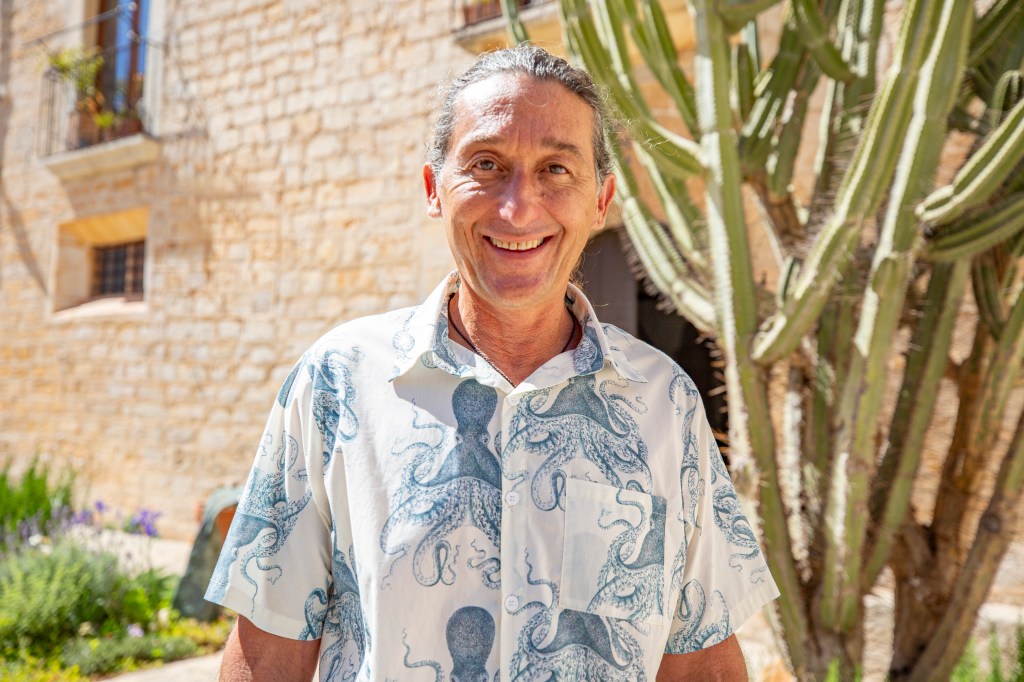
Who is Brad Robertson?

Brad Robertson is the sort of bloke you want to go and have a beer with and listen to not only what he is doing in his work life, but also what he’s done in his past. I’ve interviewed him on the radio a couple of times, and I have to be honest and say he was my inspiration to start recycling more and more. So much so now that I even pull things out of our bins at home I f they’ve not been recycled properly. My niece Florence is working for a company called the Blue Marine Foundation in the UK, a charity dedicated to restoring the ocean to health by addressing overfishing, one of the world’s biggest environmental problems. She was my inspiration to contact Brad again. So after chasing him for a chat for ages, due to us both being so busy, we finally sat down together a couple of weeks ago. 

So who is Brad Robertson?

He was born in Australia and spent most of his time on the East coast diving around the Great Barrier Reef. Which is where his love for marine life and conservation first started. He arrived in Mallorca 13 years ago from Australia with no contacts and began a land and sea business called Ondine Escape, showing people the beauty of Mallorca. As part of his business, he set up Asociación Ondine which was his way of helping the ecosystems that he was making money from. That was all fine, but it became apparent that he didn’t have the resources to cope with both. So he had the choice of keeping diving and chasing money, or following his heart and having no money! Much to his bank accounts dismay but to Mallorca’s gain, he chose the latter and concentrated on the Asociación. Eventually though, the Asociación outgrew itself and became a foundation with a new name and Save the Med was born. 

At the heart of Save the Med are four main areas of concentration, marine regeneration, scientific research, education programmes and plastic pollution reduction. 

In 2012 Sa Dragonera became the main focus for a marine protected area and after a lot of work they presented the dossier to the local government and the mainland government. In 2016 the local government recognised Sa Dragonera as a marine protected area and in 2020 it was also recognised by the Madrid government. Which was a tremendous achievement for a foundation with hardly any funding, no traction, and no reputation. The building of relationships with local and national governments is definitely key for them in the work they do.

There are many more marine protected areas, but one of the main things Brad found hard to understand was that fishing was still allowed in these areas. But what it did was make him realise that the fishermen cared just as much about the areas as he did. It led to him embracing their community to find out more about them. He then realised that they were fundamental to his ideas for marine protected areas, as they were in fact the guardians of the projects. 

Dos manos (two hands) is a 10-year-old education programme aimed at teaching children about the single use plastics industry. They teach through different methods, mainly about the harm the use of single plastics can be. I took my kids years ago to a beach clean up in Colonia de Sant Jordi organised by Brad, and it was an eye-opening experience to see what actually gets dumped. 

I asked if the foundation had ever received any money from the tourist tax? Remember, the tax was introduced to help inject funds into conserving the environment and to make tourism more sustainable for the island’s ever-increasing population in the high-season. Brad breaks off and shouts to a colleague, “Jaime, have we ever received any money from the tourist tax?” Jaime sniggers and shakes his head. Not that we’ve asked for it, says Brad, but surely these are the sort of people that should be receiving money? 

Our chat turns to single use plastics, and you can tell it’s a subject that Brad is passionate about. The textile industry and clothing in particular is a massive user of single use plastics. Brad calls it “the sleeping giant of plastic pollution”. Plastic made clothing, which is normally “poly” something, when you put them into a washing machine they let off micro fibres, which go into the water system and into the sewage and then out to sea. And so the cycle continues. 

He would love to see Real Mallorca football club have one set of their entire kit made in natural fibre. This would start a big conversation in the industries that are super saturated in money, super saturated in the urge to earn more money, and super saturated in the ability to change their behaviour. 

The message he and the foundation want to get out there is that single – use plastics do not get recycled, it’s impossible and a fact. But it still happens, and when it does get recycled it comes back as a lower quality plastic. He doesn’t know how many times it gets “recycled” but eventually it becomes useless, and then what do you do with it? In Brads words, this recycling and circular economy with plastic is complete bullshit! (Sorry for the expletive, but he says it as it is). One of the biggest lies we’ve ever been told is that single use plastic is recyclable. It isn’t and yet it is still being peddled by the recycling and rubbish management companies. The Foundation is currently focusing more on promoting reuse methods and circularity. Despite recycling being mainstream, only about 10% of plastics have been successfully recycled over the years, so there’s clearly a gap somewhere.

What message would you like us to finish on? “Before making a purchase, please consider the impact. Reuse whenever possible, and continue to support the local environmental groups in our shared mission.”

Brad is such an inspirational character and if you ever have the chance to have a beer with him, sit down and listen as it will be a complete education.

Richie is the MD at Pirates, the island’s number one night out featuring Adventure, Reloaded and Gringos. Subscribe to receive his blogs at http://www.dadtaximallorca.com

Follow him on Twitter @DadTaxi1 & Instagram @dad.taxi, or feel free to email him at rprior@globobalear.com