Positive Outlook on Mallorca Travel Amid Airline Changes

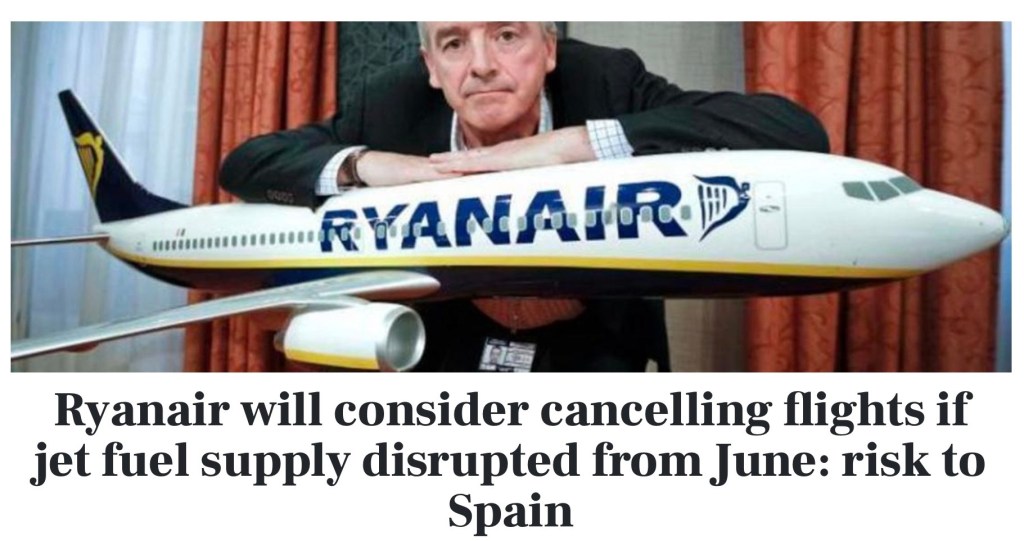
This was the headline in the Daily Express last week, and I know similar reports were seen over here. I am always a glass-half-full person, not half empty, and when I look at the outlook for travel—particularly here to Mallorca—I am pretty positive.

Michael O’Leary is never shy about saying things that create a headline—and usually, they do. But let’s take that headline into context.

Firstly, in the short term, most airlines’ seat prices are protected by 70% fuel hedging. Airline fuel hedging is a risk-management strategy where airlines use financial contracts to lock in set prices for jet fuel, shielding them from sudden, dramatic increases in oil prices. Because fuel is one of an airline’s largest operating costs, volatile prices make budgeting difficult; hedging turns this volatile expense into a predictable one.

Secondly, you can be sure that Ryanair won’t be cancelling any of its profitable routes. They’ll use this as an opportunity to dispose of any poorly sold flights. Also remember that Mallorca is a two-hour hop from pretty much every European capital city, as it lies in the centre of the Mediterranean. Therefore, fuel consumption will be much lower than, say, flying to the Canaries.

Related to that is the fact that Palma Airport is nearing completion of its redevelopment. It started in 2022 at a cost of €560 million, so that’s four years in total. Surely some of it will soon be out of date considering how long it has taken. If some airlines want to save on fuel costs, they should check their passengers into Gate D99—I’ve never known such a long walk!

Where there might be a more challenging market is in long-haul holidays and flights. But you can be sure that if the American economy starts to be affected, then Trump will have to do something. The UK is the United States’ largest overseas inbound tourism market, contributing roughly 4 to 4.6 million annual visitors and accounting for about 11.7% of all overseas visits. UK visitors often spend heavily on leisure, making it a critical, high-value source market for American tourism.

Quite a few Americans I’ve spoken to are turning on Trump and his methods of governing. His current approval rating is 39.1%, and public sentiment in the States has trended significantly downward in recent weeks, largely driven by dissatisfaction with the ongoing conflict in the Middle East and domestic economic pressures.

I personally think Trump has used this war to deflect attention away from the Epstein files, in which he is, without doubt, implicated. I also think he’s been blindsided by the reluctance of NATO countries to join in.

Our petrol prices here in Spain have been reduced due to the cut in VAT, but if this carries on for much longer, not only will petrol rise again—everything else will as well.

With the new tourist season opening this past week, we must stay positive.

Ryanair’s New Baggage Rules: What Travelers Need to Know

My last column, writing about Ryanair and the possibility of them setting up a tour operator, got some really good feedback — so thank you for that. Ryanair is a story that keeps on giving, and these past two weeks have been no exception.

They have introduced new baggage rules which, to be honest, won’t make much of a difference. I imagine I’ll just be able to bring back a few more tea bags than I did before. They have increased the maximum size of the so-called “personal item” (to be stored under the seat) from 35x20x20cm to 40x25x20cm. This is the standard allowance for all passengers. If you want to bring a larger wheelie case, you must pay for priority boarding, which includes one larger cabin bag (55x40x20cm) and a second smaller item that can be stored in the overhead locker. Don’t you just love it when the priority boarders have to get on the same bus to the airplane as the rest of us in cattle class — or is that just me?

I wish all airlines would agree on a standard size for cabin baggage. It’s very confusing. When you arrive at the gate there are so many different baggage sizers. Take a look at the photo above — and that’s only four airlines.

Ryanair will no doubt have their pack of hyenas at the gates, doing their best to ruin the start of your flight. I think some of them take pleasure in causing that misery. To make matters worse, they have increased their staff incentive programme to catch people out — from €1.50 to €2.50. This bonus used to be capped at €80 per month per person, but this has now been removed, which means they can earn as much as they want. Be warned!

I still laugh that they charge you a €45 administration fee to change a flight. I have no problem with being charged the difference between the flight I booked and the flight I am changing to. What I do object to is the so-called “admin fee.” Why? Because you actually do the admin yourself! At this rate, I’ll be charging myself for an oversized bag if I’m not careful.

They’ve also been in the news this week after apparently dropping one million seats from Spanish airports for the upcoming year. I’m led to believe that the rise equates to €0.68 per passenger. AENA, the company in charge of most of Spain’s airports, has said that it’s a 6.62% year-on-year rise. AENA also points out that Ryanair has raised its fares by 21% in the past year. Whilst this is a game of poker, it will be interesting to see if either side folds. My guess is that the routes Ryanair has dropped are their least profitable or loss-making ones and therefore won’t have a significant effect on their bottom line.

My friend and fellow podcaster Martin Makepeace, from our Talking Balearics podcast, loves Ryanair. He always books seat 17F — by the window, with legroom. Mind you, he is 6’7”, so he needs as much help as he can get!

As you can probably tell from the above, I’m not a fan. Will it stop me booking a flight with them if it’s the cheapest around? Probably not. And if any of those hyenas come snooping around, I’ll stick my bag where the sun doesn’t shine!

Ryanair Holidays

My life in Tourism began in the mid-eighties when I worked for Butlins holiday hotels as a Redcoat. My experience there led me to start work overseas here in Mallorca in 1990. I was a Holiday Rep for Intasun Holidays, working at the Guadalupe Hotel for my first season. At that time, there were loads of UK Tour Operators. Intasun were under the ILG banner which also included Global, Lancaster, Club 1830, Sol Holidays and the airline Air Europe. Their main rival was Thomson, who had Skytours, Horizon and their own airline called Brittania. There are lots of others too including, Cosmos, Owners Abroad (First Choice), Airtours and Thomas Cook. 

Remember, all this was before the internet was invented, so people booked their holidays with a travel agent or on teletext (remember that!) Low-cost airlines weren’t around at that time, although interestingly a company called Skytrain took to the air for the first time on 26 September 1977 when their inaugural flight departed London Gatwick for New York JFK. This flight carried 272 passengers on one of the airline’s 345-seat McDonnell Douglas DC-10 wide bodied aircraft. The fares charged at the time were £59 (equivalent to £463 in 2024) one-way from London and $135 (equivalent to £1,059 in 2024) one-way from New York. It makes we wonder why the owner Sir Freddie Laker decided to take on British Airways and the large American carriers at that time to fly long haul. When surely it would have been cheaper and more economical to fly short haul? He went bust five years later. 

Ryanair had been in existence since 1984 but by the mid 1990s it had become a big player in the European low-cost market, they were followed In 1996 by EasyJet with their first European flights. Both of these airlines began to totally change the way we travel and giving people the opportunity to arrange their own holidays. Interestingly starting in 1996 in Amsterdam, was Booking.com who have grown from a small Dutch start-up to one of the world’s leading digital travel companies. On the back of both Ryanair and Easyjet. 

This then led to there being fewer Tour Operators, and they started to buy each other up. The biggest mergers were in 2007 when Thomas Cook partnered with My Travel and Tui partnered with First Choice. 

2007 also saw the emergence of Jet2 Holidays who had mainly been a flight only and freight company before that. 

Fast-forward to today, and the travel landscape is very different. 

The Leading ATOL-licensed tour operators in the United Kingdom as of February 2024, ranked by number of passengers licensed, with figures from Statista are;

  1. Jet2 Holidays 
  2. TUI UK
  3. Love Holidays 
  4. Booking.com
  5. EasyJet Holidays

With all the consolidation in the holiday market there is one name that’s missing in that Tour Operating top five. Ryanair have so far resisted the temptation to delve into the package holiday market. Interestingly, though, in January this year they agreed a new partnership with Love Holidays for its customers who wish to book low-cost package holidays. This deal allows Love Holidays customers to buy Ryanair flights, seats, and bags as part of their love holidays package at Ryanair’s low prices.

Don’t be surprised to see Ryanair take that partnership further by buying Love Holidays or another online travel agent and launching Ryanair Holidays. It seems the natural way forward and having seen what EasyJet have done, I’m sure they won’t be far behind.