Back in January 2020, the Balearic government passed a decree law against the so-called “tourism of excesses” and for the improvement of quality in tourist zones. They singled out the resorts of Arenal, Playa de Palma, and Magaluf in Mallorca, and San Antonio in Ibiza, as the areas that would be affected.
At the time, these laws didn’t really come into effect as the pandemic took over, but when everything returned in 2022, they were put into practice.
In 2024, after the elections, the laws were relaxed a little—but what has changed in these resorts since 2020? Well, having lived and worked in Magaluf since 1990, I think I’m well placed to tell you about it. I’ve also asked my good friend Martin Makepeace to give you a view on San Antonio in Ibiza. We do a weekly podcast called Talking Balearics, where we talk about Mallorca and Ibiza. Martin, like me, has lived in Ibiza for over 30 years.
Magaluf, ever since I’ve known it, has had a reputation—some see that as bad, others see it as an opportunity for good.
When I arrived in 1990, families and young people mixed without any problems—even in the winter. Slowly but surely, that balance ebbed away, and the headlines became worse and worse. You didn’t need to be a rocket scientist to know that something had to change.
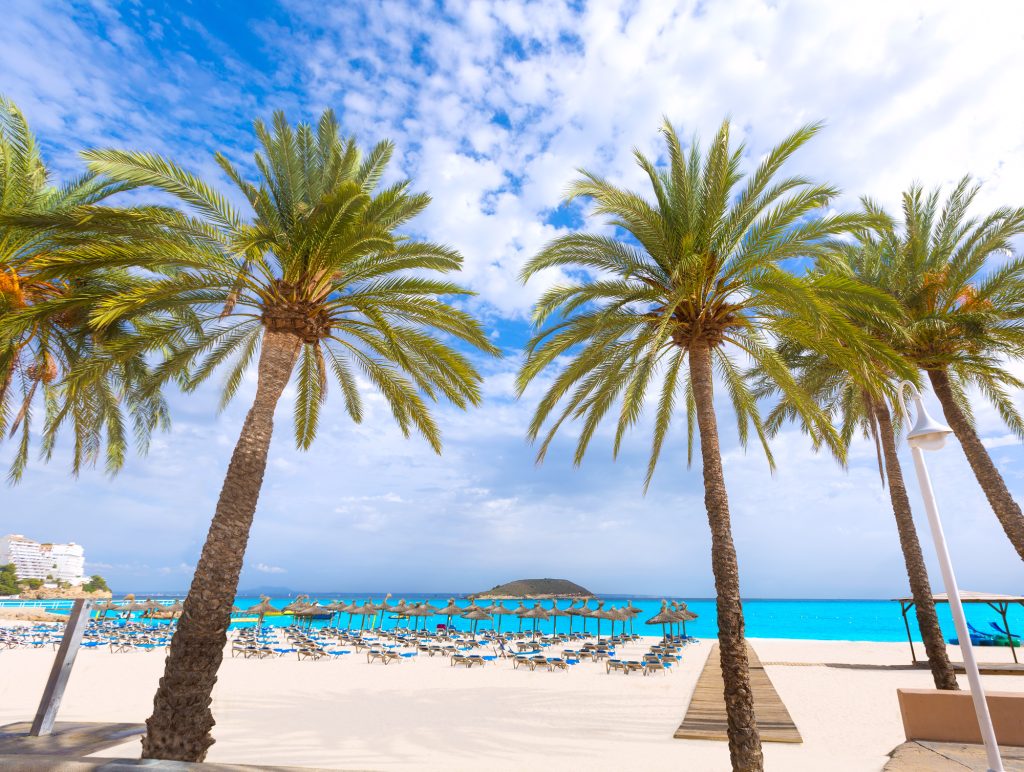
Meliá was the first to invest in the resort, followed by pretty much every other hotel chain, meaning that over 75% of the hotels in Magaluf are now either 4 or 5-star. Anyone in the know will tell you that Magaluf beach is still one of the best on the island. A new four-million-euro promenade is being built as we speak, with phase one due for completion at the beginning of May. Phase two will be completed in the early part of 2026.
In my opinion, the measures brought in were a bit draconian and wouldn’t have been needed if the resort had been policed properly. The map of the so-called “Red Zone” was drawn in a way that benefited some businesses and not others. It should have been a blanket ban or nothing at all.
It was the short-sightedness of authorities in the past that meant they didn’t understand that the youngsters of today will be the families of the future. Most of my friends had been to Magaluf in their teenage years. They loved it so much that, fast forward five years, they were coming back and staying in a four or five-star hotel. Fast forward another five or ten years, they were renting villas with their families—and all of a sudden, they are the clientele that the authorities want.
You need to give people a taste of what your tourism product is at a relatively early age and hope that it ignites that blue touch paper. They then become bonded and emotionally attached to that location for the rest of their lives.
My list of positives about Magaluf is endless. And when you look closely, it’s a resort that still mixes families and youngsters—and, in my opinion, for longer throughout the year. For families, there’s Pirates, Gringos Family Rave, Western Water Park, karting, Katmandu, the beach, and countless bars, beach bars, cafés, and restaurants to cater to their needs.
For youngsters, there’s Reloaded & Gringos, Oceans Beach, BCM, The Strip, the beach—and again, countless bars, beach bars, cafés, and restaurants to cater to their needs.
I like the new Mayor and his administration in Calvia and believe the changes that are being made are good for the future. Magaluf has changed for the better, and my love for it doesn’t diminish.
Reputation is everything, and the court of public opinion can be a brutal place, passing judgment without the full facts. But times change.
San Antonio, or Sant Antoni de Portmany to use its official name, is a great example. The stigma of the 80s and 90s still lingers—but it ain’t 1987 anymore. It’s 2025, and the shackles have been released.
New luxury hotels, top-end restaurants serving delicious food, world-class entertainment venues, a sunset that many say is the best on the planet—and more importantly, a young, ambitious mayor who’s not afraid to try new things, improve infrastructure, and make big plans for the future with major investment.
San Antonio now has some of the most expensive real estate in Spain and is already the most expensive place to rent. The gentrification process continues unabated on a small island with limited space. This is the yin and yang of an island that has seen incredible growth over the last 15 years.
Being comfortable in your own skin takes time, and Ibiza’s second-largest town is finally the mature adult it wanted to be—rather than a sulky teenager prone to bouts of self-harm.
“It’s a process” is a well-used phrase, and the perception of San Antonio is no different. But this can only be changed by a potent mixture of self-awareness, communication, consistency, and patience. The town is now controlling its own narrative—with actions rather than words.
New and improved pedestrianised areas, world-famous street art, a new environmentally friendly summer police station, a spanking new port area, plans for cutting-edge sports facilities… and this is just in the last 12 months!
The future is bright. San Antonio isn’t walking into the future—it’s sprinting with confidence.
We both feel that the tourist model of Mallorca and Ibiza is changing for the better—and will need to change even more to keep up with its competitors.
You can hear “Talking Balearics” every week wherever you get your podcasts and Martins blog is https://maninsanan.com

 Dad Taxi Mallorca