Mallorca’s Tourism Strategy: Diversification and Sustainability Goals

This past week has seen the World Travel Market in London, where the great and the good of the travel world descend on the Excel Centre to showcase their wares. Mallorca focused on diversification and sustainability as the new buzzwords, while the Government continues to fend off questions about tourismphobia.

There are three main travel markets in Europe: the WTM in London in November, Fitur in Madrid in January, and the ITB in Berlin in March. The majority of Mallorca’s tourist numbers come from three countries:

Germany: The largest single source market for tourists in Mallorca, accounting for around 40% of total tourist traffic. In 2024, estimates suggest over 5 million German visitors. Reports indicate that this year there has been a decrease in the number of German tourists.

United Kingdom: The second-largest market, typically making up around 26% of visitors. In 2024, there were an estimated 3.58 million British tourists. Reports suggest that the British helped save the summer season this year, with a slight decline in visitor numbers in July and August but a significant increase in September.

Spain: Domestic tourism from mainland Spain is also a key market, with approximately 1.8 million visitors estimated in 2024.

We are starting to see more and more visitors from other countries. In my concierge business, I have met and spoken with people from the USA, France, Italy, Austria, Scandinavia, the Netherlands, Iraq, and Singapore. Next year, we are expecting flights from Canada, Abu Dhabi, and possibly South Africa.

For me, it is fundamental that we are represented at these travel markets. I often see comments online such as, “Why are we going when we’re always full?” and “Do we really need to spend this money?”

Marketing is crucial for sustainable growth — not just for attracting more visitors. It helps draw in a higher-spending demographic, which is something the Government is keen to encourage. It also helps spread tourism throughout the year and attracts people interested in different types of activities, helping to manage and reduce pressure during peak times. In addition, it can attract tourists with different needs and preferences, which in turn diversifies the local economy and ensures long-term stability.

Not being represented may not have a noticeable effect on tourism numbers in the short term, but you can be sure that in the long term, we would start to suffer. Competition among destinations is increasing, and according to the organisers of the WTM, London 2025 is expected to be the largest event in its 45-year history. Early indicators show significant growth, surpassing the more than 4,000 exhibitors from 2024, with an 8% increase expected.

Let’s be clear: tourism accounts for approximately 45% of Mallorca’s GDP, making it the island’s primary economic driver. The sector’s total impact is even greater, with analyses suggesting it influences up to 90% of the island’s economy through indirect effects on other industries. Most of us have a family member or friend who works in tourism.

Sustainability will be a vital part of our tourism strategy in the coming years. One change I would make immediately is to the tourist tax — I would charge a fixed fee all year round for every traveller.

At the moment:

• Under-16s don’t pay.

• Rates vary depending on the type of accommodation.

• There’s a 50% reduction if you stay longer than nine nights.

• It’s discounted during the low season.

Let’s be in no doubt: the island’s beauty must be maintained for generations to come — but we should also be proud of what we have. I’ve said it before, and I’ll keep saying it:

We are a beautiful island of contrasts — from the stunning beaches in the north to the mountains of the west, the caves and coves of the east, and the bustling nightlife of the south. There is something here for absolutely everyone.

If ever there was a destination built for tourism, it’s our island. It hasn’t been one of the most popular islands in the world for the past 50 years for nothing. In my opinion, it remains one of the best places to live and one of the best holiday destinations anywhere.

We can boast turquoise-blue waters, secret coves, soft golden sands, lush green landscapes, rugged mountains, picturesque villages, amazing cuisine, an up-and-coming wine industry, vibrant nightlife, and a lively capital city. And we’re just a couple of hours’ flight from most major European cities — right in the heart of the Mediterranean.

As someone who lives and works here, I see Mallorca’s magic every single day — in the people, the landscapes, and the memories our visitors take home. If we can combine smart marketing with genuine care for our environment and communities, I have no doubt that Mallorca will continue to shine as the jewel of the Mediterranean for decades to come.

Mallorca’s Extreme Weather: Lessons from Recent Storms

The weather has been hitting the headlines here for all the wrong reasons over the last couple of weeks. The islands were hit badly by the storms, with Ibiza probably getting the worst of it.

I really believe we are sleepwalking into another flooding disaster, like the one we experienced back in 2018 here in Mallorca. If you can’t remember that awful night seven years ago, here’s an excerpt from my blog at the time:

“Thoughts and prayers are with the people of San Llorenç and the surrounding areas this week. Living on a holiday island, you never expect us to be hit by the kind of storm that hit last Tuesday. Shocking videos and pictures were all over social media, and I think the realisation of how bad it was only dawned the following morning. Thirteen people tragically lost their lives, making it one of the worst natural disasters here on record.”

That storm happened at night, and the true devastation it caused only really became apparent the morning after. I don’t think even the word apocalyptic describes it — it was truly shocking.

The storms were caused by an extreme weather event with a massive amount of rainfall, exacerbated by factors including the town’s geography, existing infrastructure, and the difficulty of accurately forecasting the disaster. There was also a subsequent discussion about potential shortcomings in the emergency response and planning.

So here we are, seven years later — and what have we learned? Well, after talking to my Talking Balearics podcast partner, Martin Makepeace, who lives in Ibiza, the answer is: precious little. Ibiza bore the brunt of it, and the warnings that did come arrived too late. Martin, like me, has a blog called Man in San An.

He wrote:

“Saturated streets, mudslides, rockfalls, collapsed roofs, DC10 underwater, UNVRS without power, flights missed, cars submerged, tunnels full of water, the port of Ibiza cascading with water as passengers disembarked up to their knees, and the two most important hubs of the island – the airport and hospital – both leaking like a sieve. This was a generational event that will be spoken about for years to come.”

Remind you of anything?

The only good thing to come out of these recent awful storms is that there was no loss of life — probably more by luck than by preventative measures.

Back in June, we learned that since its inception in 2016 and up until the end of 2023, the tourist tax had raised a total of 698 million euros. Of this total, 218 million euros relating to the years 2020 to 2022 were used to cover needs arising from the pandemic. Of the remaining 480 million euros, only 59 million had been spent on fully implemented projects — a touch over 12%!

Remember, the tax was introduced to offset the environmental and territorial impact of mass tourism by funding projects for environmental conservation, cultural heritage restoration, and the promotion of sustainable tourism. It also aims to compensate local residents for the strain tourism places on the islands’ resources and infrastructure.

If ever there was a time to spend some of this money on our islands’ infrastructure, it’s now. Well, it was after the storms of 2018 — but when you look into the management of the tax, you seriously wonder who is actually running this absolute s…show (sorry, I couldn’t find a better word!).

The Public Audit Office has criticised the “chaos and lack of control” in the management of the tax up to 2023 — one of the reasons there has been such a low level of project execution. Difficulties the Audit Office encountered in preparing this report have led it not even to issue an audit report. It cannot endorse tax data or guarantee that the law has been complied with, or will be complied with, throughout the processes pertaining to the various projects. I actually can’t believe I’m writing this.

Now we learn that the Balearic Government — which has changed since the tax was first implemented — would like to increase it further. Surely they should be looking at the management of the money that hasn’t yet been spent first?

According to the experts, global warming is making weather more extreme and unpredictable by causing hotter temperatures, more severe storms, and more frequent and intense droughts. This is driven by rising global temperatures, which lead to more evaporation and moisture in the atmosphere, fuelling powerful storms like hurricanes and causing intense rainfall or longer periods of drought. Melting ice and warming oceans also contribute to sea-level rise, which exacerbates coastal flooding from storms.

I just hope someone here realises the seriousness of this — and sorts this mess out.

Discover Mallorca: An Emerging International Destination

Mallorca is developing more and more into an international destination, and with that, more opportunities are becoming available to those of us living and working here. The truth is, why would you not want to come here?

We are a beautiful island of contrast, from the stunning beaches in the north to the mountains of the west, the caves and coves of the east, and the bustling nightlife of the south. There is something for absolutely everyone.

If ever there was a destination built for tourism, it is our island. It hasn’t been one of the most popular islands in the world for the last 50 years for nothing. In my opinion, it remains one of the best places to live and one of the finest holiday destinations. We can boast turquoise-blue waters, secret coves, soft golden sands, lush green foliage, rugged mountains, picturesque villages, amazing cuisine, an up-and-coming wine industry, a lively nightlife scene, and a vibrant capital city. We’re also an island in the Mediterranean, just a couple of hours’ flight from most European cities.

Palma Airport, which is Spain’s third busiest, is currently undergoing a €559 million expansion and modernization by its owner, AENA. The project began in 2022 and is expected to be completed by the end of 2026. Its purpose is to improve the airport’s passenger-friendliness, efficiency, and sustainability.

One thing that is changing is the increasing number of direct flights arriving from outside of Europe. It used to be that anyone coming from further afield had to visit us via Madrid, Barcelona, or another European city. Since the pandemic and around the start of the airport expansion, things have started to change. In June 2022, a direct flight from New York to Palma began operating, and its frequency has increased every year. From June 17th to October 24th, 2026, Air Canada will launch a direct flight between Montreal and the island, and Etihad Airways has officially announced that it will begin direct flights between Abu Dhabi and Mallorca starting June 12th, 2026, running through to mid-September. This will be the first-ever direct connection between the UAE and Mallorca, and currently the only direct air link between Asia and the island — a landmark moment in Mallorca’s international connectivity.

Not only are all these connections great for the island but let’s remember we now have the opportunity to travel to these destinations for either business or pleasure. Making it a win-win situation.

Friends of mine in the wedding industry here on the island tell me that since the flights from New York began, there has been a steady increase in American couples getting married here. Friends in the property world also say that more and more foreign buyers are being lured to the island because of its beauty and great connectivity.

Not only is this good for business here but this also has a knock-on effect on many third-party businesses that may not be directly involved in these industries but will benefit from their growth.

I see all of this as positive, but I also understand that the sustainability aspect needs to be seriously looked at and addressed in a constructive way. We need to continue working to extend our seasonality. A 12 month year round Mallorca is far more appealing then a 6 month one and it could well lighten the load on the summer months. I see this slowly moving in the right direction, and we need to look at how we can better cope during the busiest months of the year, July and August. For Mallorca to become a year-round destination, we all need to work harder during the shoulder months to achieve this. Don’t listen to the naysayers who constantly say it can’t be done — Magaluf is now a perfect example of how positive change can happen. Keep those glasses half full!

Climbing the Football Ladder: A Family’s Journey

We have two sons who are both working hard to climb the football ladder. Our eldest, Jacob, at 19 years old, is starting on the path to becoming a coach. He has been working at the Borussia Dortmund International Academy Mallorca for a couple of years, running various training sessions. This year, however, he will be coaching his own team while studying for a UEFA C licence and completing his education with an FP Superior in Sport.

Our youngest, Jude, at 16 years old, has his sights set on becoming a professional goalkeeper. He is playing at the second-highest level of youth football with Palma FC while studying for an FP in Sport, just like his brother.

Both realise that they are on a difficult path, as very few actually make it, which is why their studies become so important.

Footballers who do make it enter a life that most of us can only dream of. Whilst most behave in a manner befitting their standing, unfortunately there are some who don’t. Several cases have come to light this season, both here in Mallorca and back in the Premier League.

Dani Rodríguez is a player I admire at Real Mallorca. He has been at the club since January 2018 and always gives 100%. However, a couple of weeks ago he let himself down. He was suspended by the club after publicly criticising the club and coach on social media following a loss to Real Madrid. He was frustrated at not being brought into the game—especially as his family was watching—and questioned the value of loyalty and hard work in the dressing room. The club responded by suspending him for 10 days without pay and permanently removing him as vice-captain.

I hope he can train his way back into the team, whether under the current coach or another one (that’s for another day!).

Players thinking they are above the law are becoming more and more common. The case of Alexander Isak is probably the biggest one this summer. He refused to play for his parent club, Newcastle, while still under contract, in an attempt to force a move to Liverpool, who had submitted a bid for him. On the other hand, you have a club like Chelsea, who have sidelined two of their squad players—Raheem Sterling and Axel Disasi—making them train in the evenings, away from the first-team squad. The Professional Footballers’ Association (PFA) has become involved, reminding Chelsea of their duty of care.

But where were the PFA in the case of Isak, telling him he should fulfil his contractual obligations? You heard nothing from them. Yet when it comes to a player like Sterling, they suddenly come out of the woodwork and get involved. I am sure these players had opportunities to move on in the summer but, for whatever reason, chose not to. They are still being paid and have access to all the facilities provided to the first team. In Sterling’s case, he is still earning £325,000 a week! On that amount of money, I’d be training all day, all night, and twice on Wednesdays! I’m sorry, but the “duty of care” argument in this case doesn’t wash with me.

We have taught our sons to be respectful to others, and we hope that if either—or both—of them make it into the big wide world of football, they continue in that vein. As the old saying goes: be nice to the people on your way up, because you might well meet them on your way back down!

Ryanair’s New Baggage Rules: What Travelers Need to Know

My last column, writing about Ryanair and the possibility of them setting up a tour operator, got some really good feedback — so thank you for that. Ryanair is a story that keeps on giving, and these past two weeks have been no exception.

They have introduced new baggage rules which, to be honest, won’t make much of a difference. I imagine I’ll just be able to bring back a few more tea bags than I did before. They have increased the maximum size of the so-called “personal item” (to be stored under the seat) from 35x20x20cm to 40x25x20cm. This is the standard allowance for all passengers. If you want to bring a larger wheelie case, you must pay for priority boarding, which includes one larger cabin bag (55x40x20cm) and a second smaller item that can be stored in the overhead locker. Don’t you just love it when the priority boarders have to get on the same bus to the airplane as the rest of us in cattle class — or is that just me?

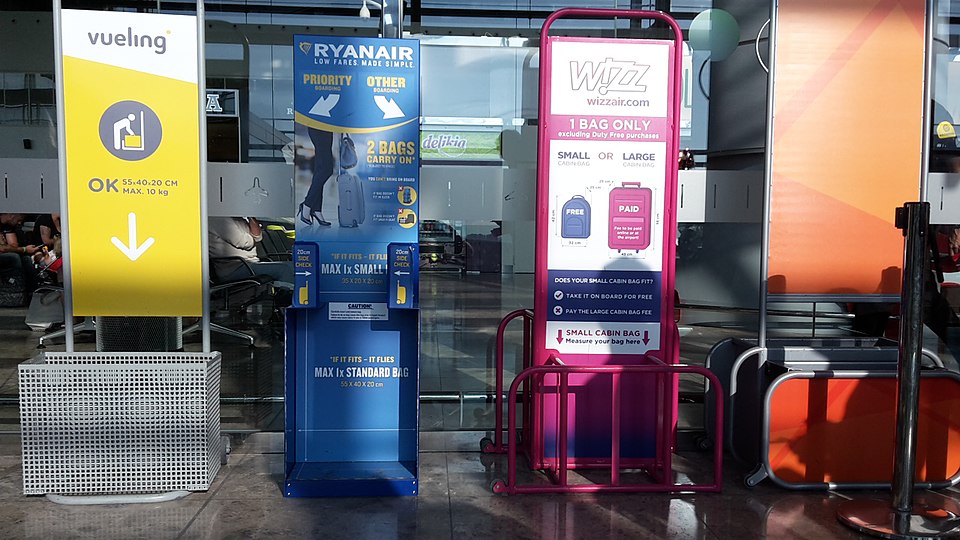
I wish all airlines would agree on a standard size for cabin baggage. It’s very confusing. When you arrive at the gate there are so many different baggage sizers. Take a look at the photo above — and that’s only four airlines.

Ryanair will no doubt have their pack of hyenas at the gates, doing their best to ruin the start of your flight. I think some of them take pleasure in causing that misery. To make matters worse, they have increased their staff incentive programme to catch people out — from €1.50 to €2.50. This bonus used to be capped at €80 per month per person, but this has now been removed, which means they can earn as much as they want. Be warned!

I still laugh that they charge you a €45 administration fee to change a flight. I have no problem with being charged the difference between the flight I booked and the flight I am changing to. What I do object to is the so-called “admin fee.” Why? Because you actually do the admin yourself! At this rate, I’ll be charging myself for an oversized bag if I’m not careful.

They’ve also been in the news this week after apparently dropping one million seats from Spanish airports for the upcoming year. I’m led to believe that the rise equates to €0.68 per passenger. AENA, the company in charge of most of Spain’s airports, has said that it’s a 6.62% year-on-year rise. AENA also points out that Ryanair has raised its fares by 21% in the past year. Whilst this is a game of poker, it will be interesting to see if either side folds. My guess is that the routes Ryanair has dropped are their least profitable or loss-making ones and therefore won’t have a significant effect on their bottom line.

My friend and fellow podcaster Martin Makepeace, from our Talking Balearics podcast, loves Ryanair. He always books seat 17F — by the window, with legroom. Mind you, he is 6’7”, so he needs as much help as he can get!

As you can probably tell from the above, I’m not a fan. Will it stop me booking a flight with them if it’s the cheapest around? Probably not. And if any of those hyenas come snooping around, I’ll stick my bag where the sun doesn’t shine!

Ryanair

My last column, writing about Ryanair and the possibility of them setting up a tour operator, got some really good feedback — so thank you for that. Ryanair is a story that keeps on giving, and these past two weeks have been no exception.

They have introduced new baggage rules which, to be honest, won’t make much of a difference. I imagine I’ll just be able to bring back a few more tea bags than I did before. They have increased the maximum size of the so-called “personal item” (to be stored under the seat) from 35x20x20cm to 40x25x20cm. This is the standard allowance for all passengers. If you want to bring a larger wheelie case, you must pay for priority boarding, which includes one larger cabin bag (55x40x20cm) and a second smaller item that can be stored in the overhead locker. Don’t you just love it when the priority boarders have to get on the same bus to the airplane as the rest of us in cattle class — or is that just me?

I wish all airlines would agree on a standard size for cabin baggage. It’s very confusing. When you arrive at the gate there are so many different baggage sizers. Take a look at the photo above — and that’s only four airlines.

Ryanair will no doubt have their pack of hyenas at the gates, doing their best to ruin the start of your flight. I think some of them take pleasure in causing that misery. To make matters worse, they have increased their staff incentive programme to catch people out — from €1.50 to €2.50. This bonus used to be capped at €80 per month per person, but this has now been removed, which means they can earn as much as they want. Be warned!

I still laugh that they charge you a €45 administration fee to change a flight. I have no problem with being charged the difference between the flight I booked and the flight I am changing to. What I do object to is the so-called “admin fee.” Why? Because you actually do the admin yourself! At this rate, I’ll be charging myself for an oversized bag if I’m not careful.

They’ve also been in the news this week after apparently dropping one million seats from Spanish airports for the upcoming year. I’m led to believe that the rise equates to €0.68 per passenger. AENA, the company in charge of most of Spain’s airports, has said that it’s a 6.62% year-on-year rise. AENA also points out that Ryanair has raised its fares by 21% in the past year. Whilst this is a game of poker, it will be interesting to see if either side folds. My guess is that the routes Ryanair has dropped are their least profitable or loss-making ones and therefore won’t have a significant effect on their bottom line.

My friend and fellow podcaster Martin Makepeace, from our Talking Balearics podcast, loves Ryanair. He always books seat 17F — by the window, with legroom. Mind you, he is 6’7”, so he needs as much help as he can get!

As you can probably tell from the above, I’m not a fan. Will it stop me booking a flight with them if it’s the cheapest around? Probably not. And if any of those hyenas come snooping around, I’ll stick my bag where the sun doesn’t shine!

Evolution of the UK Holiday Industry: A Historical Overview

When I joined the tour operating world in 1990, tour operators were two a penny. ILG, the company I worked for, had numerous brands such as Intasun, Lancaster, Global, Club 18–30, and Horizon, to name just a few. After they went bust in 1991, the tour operating world started to change.

The major players then were Thomson, Airtours, Thomas Cook, and Owners Abroad, which rebranded as First Choice in 1994. After the Gulf War of the early ’90s, the holiday industry started to recover. Although the internet had begun, people were still booking their holidays at travel agents such as Lunn Poly, Thomas Cook, and Going Places. Who remembers searching the TV for a Teletext holiday? Unbelievable now when you think about it.

By the mid-’90s, the European Council relaxed the rules to create a common aviation area across Europe, and this was the start of the no-frills airline revolution. Ryanair, a company that had started in 1984, was known—believe it or not—for its customer service! In 1988, Michael O’Leary, who was an accountant at the time, was sent in to try and save Ryanair as it was losing millions of pounds. EasyJet started in 1995 when Stelios Haji-Ioannou took a loan from his shipping-tycoon father. He said at the time he didn’t have a clue what he was doing. Interestingly, both companies looked to the American airline Southwest for inspiration in building what you see today.

Between 1996 and 2015, passenger numbers at UK airports increased by 85 percent, from 135 million to 251 million—driven by flights sold by low-cost carriers and online booking. The traffic was also coming from more regional airports such as Stansted, Luton, and Liverpool.

This was definitely having an effect on the tour operators, with people now booking directly or with dynamic packaging companies, often for shorter trips. The traditional 7- or 14-night holiday was becoming a thing of the past. This squeeze brought about mergers: Airtours (rebranded as MyTravel in 2002) merged with Thomas Cook in 2007, and in the same year TUI, which operated the Thomson brand, merged with First Choice. Around this time, OTAs (Online Travel Agents) started to take off. On the Beach launched in 2004 from a terraced house in Macclesfield, and Love Holidays began in 2012.

The 9/11 attacks, subsequent wars, the global financial crisis, and the pandemic wreaked havoc across the holiday industry over the years, ultimately leading to the collapse of Thomas Cook in September 2019.

That left a gap in the market, which was filled by a company that had actually started in 1971 as Carpenters Air Services, flying flowers from Guernsey to the UK. After going through various guises, Jet2 launched its first scheduled leisure flight from Leeds Bradford Airport in 2003. In 2007, its holiday division was launched, and it has since become the leader in the package holiday industry.

Another company that began to fill the Thomas Cook void was already an established player in the airline industry. In November 2019, EasyJet Holidays was launched. It quickly realised that a seat sold as part of a package holiday generated more money per head than a seat-only sale.

When you look at the top five ATOL (Air Travel Organiser’s Licence) holders as of April 2025, it makes for interesting reading:

1. Jet2holidays

2. TUI

3. Loveholidays

4. easyJet Holidays

5. On the Beach

Now, I know you may think I’m mad, but don’t be surprised to see Ryanair Holidays within the next five years—or maybe even sooner. In fact, in a roundabout sort of way, they already exist without you knowing it. Ryanair has many partners in the holiday world, but the most recognisable are TUI, On the Beach, and Love Holidays—all of which include Ryanair flights in their packages. So don’t be surprised if Ryanair eventually takes over either On the Beach or Love Holidays in the future.

To borrow a football analogy: the holiday industry is a funny old game!

Impactful Charity Work Through The Radiothon

One thing I definitely missed when I gave up working in radio in 2022 was the charity work. As soon as we decided to start another station, the Radiothon was already being organised. After opening in February, we decided to wait until we were more established before setting a date.

With any charity work, I think it’s very important that everyone who has helped us raise money knows where it is going and how we are helping. I asked each charity to let us know how our donation would help them.

Great Ormond Street Hospital Children’s Charity (GOSH)

My relationship with GOSH dates back to 2004 through my work with Pirates and the Pirates Charity Premieres. When the Premieres ended in 2016, I continued supporting GOSH through the Radiothons. I’ve also run the London Marathon twice for them, in 2008 and 2010, raising £10,867.00.

Through the Premieres and Radiothons, I am very proud to say we have now raised a total of €766,057.60 for GOSH, supporting many important projects over the years.

Laura Foy, Senior Fundraising Executive – Partnership Management, wrote:

“Every day, around 750 seriously ill children and young people are seen at Great Ormond Street Hospital (GOSH). Your support through the Radiothon is helping to build a brighter future for them.

With your support, GOSH Charity helps fund advanced medical equipment for treating the toughest conditions, as well as support services that help make life in hospital as normal as possible for young patients and their families. The funds raised also support pioneering research to find treatments and cures for rare and complex childhood illnesses. And thanks to your fundraising, we can build the new Children’s Cancer Centre at Great Ormond Street Hospital. Cancer is the biggest killer of children aged one to 14 in the UK, and this centre will help us beat cancer for more children.

Whether it’s the children at the hospital right now, or the patients of tomorrow, you are making a difference. GOSH has always depended on generous supporters like you to enable seriously ill children to fulfil their potential. The incredible support from people like you means everything to the children and families at GOSH, who are facing some of the hardest challenges of their lives.

On behalf of the children, families and staff at GOSH, thank you so much for generously supporting the Radiothon!”

Thanks,

Laura

Son Espases Hospital

We have a great relationship with our local public hospital in Palma. Since we started the Radiothon in 2015, we have raised €49,424.87 for the hospital.

Our work with them has been in the paediatric department and the children’s intensive care unit. Money raised in previous years has helped fund various projects, including decorating an MRI scanner and its room, painting the paediatric ward doors with cartoon characters, creating a brand-new waiting room for parents with children in intensive care, and many other smaller projects.

Natalia Vallés Ruiz, Head of Nursing, told me:

“In order to improve the paediatric patient’s hospital experience and reduce fear and anxiety associated with certain medical procedures, Son Espases has developed a collection of stories specially designed for different moments in the care process for children.

The main character is URPI, the mascot of the Paediatrics Emergency Department. As part of this project, a specific story has been created in which URPI accompanies the child throughout the entire care process, acting as a guide and a friend, helping them feel more comfortable and providing emotional security.

The main purpose of this resource is to reduce fear and anxiety during medical procedures. The activity is conceived as a ‘special mission’ while health professionals carry out the necessary procedures.

Funding from the Radiothon will be used to decorate part of the Paediatric Emergency Department, continue developing and producing visual and narrative materials, and work towards the final goal: fully decorating the Paediatrics ER.”

Many thanks,

Natalia

Yachting Gives Back

Nick Entwistle set up YGB in 2019 after retiring from Pinmar Yachting, with the aim of fighting hunger and poverty in Mallorca. It is supported by donations from superyachts, the yachting community, and beyond.

Dear Richie,

Very many thanks to you and your lovely team at Wave Mallorca Radio, together with your generous sponsors and donors, for the wonderful donation from your very successful Radiothon.

We have already used some of the funds to buy a much-needed new fridge freezer for the Can Gazà shelter, and we look forward to putting the rest to good use—probably on our monthly shopping trips for Can Gazà, Siloé, Mallorca Sense Fam, and SOS Mamás.

We are hugely grateful for your continuing support and very proud to deliver so much help to the local community on your behalf.

With best regards,

Nick, Anne, Paddy, Jan and Ruth

Yachting Gives Back

6Points Cycling Challenges

This was conceived by Bryan Visser in 2016 as an individual rider charity ride around Mallorca. It has grown from 6 riders in 2016 to 76 riders in May this year.

Dear Richie,

On behalf of 6Points Cycling Challenges and our three charities—Asdica, SOS Animal and Shambhala—I am delighted to thank you for including us in your Radiothon and for donating €2,872.50.

It was a pleasure to work with you during the Radiothon and to host a 6Point Ride to add value to your endeavours.

Your wonderful donation has been topped up to €3,000 and equally shared between our three charities. The money has already been paid to them, and they are delighted!

With heartfelt thanks,

Yours sincerely,

Bryan Visser

6Points Challenges

Cancer Support Mallorca

Back in 2011, Krista Hyer set up the group with the aim of helping patients, carers, and anyone affected by cancer. Krista sadly passed away in 2022, but her amazing work has been carried on by Rebecca Upton and Bronwen Griffiths Thomas.

A heartfelt thank you to Wave Mallorca Radio and all the incredible listeners who supported the recent Radiothon in aid of Cancer Support Mallorca.

Thanks to your generosity, the money raised will go a long way in helping us continue our vital work supporting cancer patients and their families across the island. It means we can:

– Provide free translation and interpretation for medical appointments

– Offer transport to and from treatments for those without support

– Give access to nutritional advice and wellbeing programmes

– Provide counselling and emotional support to patients and caregivers

– Carry out home visits for those unable to travel

– Assist with end-of-life planning and grief support

Every euro raised helps ensure that no one has to face cancer alone.

Thank you for being part of our mission.

Rebecca & Bronwen

With the donations from this year added to all the other Radiothons since 2015, we have now raised €211,892.44. I keep saying this—we are just the messengers, and you, the listeners and readers are the ones who help us achieve our goals for charity. I see it as one big community that can only grow stronger in the years to come, continuing to help those in need.

Thank you!

Real Mallorca’s Growth: A Community Football Vision

This weekend sees the return of La Liga here in Spain, and for fans of Real Mallorca, it’s another season where the first aim is to avoid the drop. Having finished in a very impressive 10th place last year, you’d think relegation wouldn’t be on our minds—but we all know Mallorca too well. This season will be their fifth consecutive one in La Liga, and the growth in interest in the club has been enormous. Since their promotion in the 2020/21 season, they have gone from 14,471 season ticket holders to 23,044 this season.

You cannot help but applaud the American owners for what they have done since buying the club in 2016. One sticking point in the sale of the club, however, was that the ownership of the stadium is not directly tied to the club’s ownership structure. While RCD Mallorca has a long-term agreement to use the stadium, the facility is owned by the local government, specifically the Consell de Mallorca. The club has a 50-year agreement with the city council to use the stadium, which they have occupied since 1999.

Where I think the Americans have been very clever is in getting their stadium improvements approved by the government in return for agreeing to open the stadium year-round. Both parties are working together to ensure it is not just a football venue but a place that serves the local community throughout the year. The broader aim is to increase the stadium’s accessibility and utility for residents of Mallorca, promoting it as a place for recreation, events, and social interaction.

Last month I had a tour of the stadium to see the improvements and to learn about how the La Liga salary cap works and how they manage ticketing. They had just finished a series of outdoor concerts on the pitch, which was being dug up and replaced. At that point, you would have thought it impossible to host La Liga matches just a month later.

The stadium is very impressive these days. With the running track gone, fans are much closer to the pitch, making the atmosphere far more intense. But it’s also behind the scenes where you notice the biggest changes. They have gone all-in on corporate hospitality, adding a tunnel experience, private boxes, and various lounges where you can enjoy food and drink both before and after the game. While I was there, stadium tours were running, the Mallorca Sports Bar was open, and a new sports clinic had just launched. The club shop has been transformed into a state-of-the-art space that does a roaring trade, not only on match days. Conference facilities of various sizes are now available around the stadium.

Every one of these extras contributes to how the salary cap is calculated for the club. La Liga’s salary cap, known as the Squad Cost Limit, restricts how much clubs can spend on player and staff wages, amortised transfer fees, and other related expenses. This limit is determined by each club’s projected revenue and expenses for the season, including debt repayment and overheads. So, all this investment ultimately supports the entire playing structure of the club, from the first team right down to the youth levels.

There’s little to criticise the owners for, but one thing I don’t understand is why the club doesn’t yet have a women’s team. You’d think that with Spain and the USA ranked number 1 and 2 in the world, respectively, they would. The other professional team on the island, Atlético Baleares, does have one, and they play in the second tier of women’s Spanish football.

Mallorca has produced outstanding women’s talent. Three players from the island were in Spain’s national team at the European Championships: goalkeeper Cata Coll from Pòrtol, midfielder Patri Guijarro from Palma, and forward Mariona Caldentey from Felanitx. All three started in the final against England. So, the talent is definitely here.

I’m hearing that Mallorca will finally launch a women’s team ahead of the 2025/26 season. It will initially compete in the Alevín eight-a-side category, for players aged 10 and 11. The club has emphasised a long-term commitment to the women’s programme, ensuring it will be a serious project with dedicated staff and resources.

Prior to this launch, the club focused on stabilising the men’s team and building a solid foundation for growth. The women’s team will be fully integrated into the club’s football structure, with shared facilities and staff. Hopefully, that will evolve into a full programme for women, giving girls on the island the chance to pursue their dreams here rather than having to go elsewhere.

The wait is over for the first team—and tonight they face the small matter of current La Liga champions Barcelona in their opening match.

Visca Mallorca!

Navigating Car Hire Insurance: What You Need to Know

With all the travelling I do, I take out insurance that covers me for all the cars I rent. It is without doubt the cheaper way to do things. A year’s cost is usually about the same as taking out two fully comprehensive insurances that you pay as an add-on at the rental desk when you arrive. Most car hire companies will put you on third-party insurance and then add the fully comprehensive cover when you collect the car.

By taking out your own insurance, you avoid that cost—but you have to be aware that the excess charge is usually quite hefty. Obviously, this takes away the opportunity for car hire companies to make extra money from customers, so they try to make it as difficult as possible.

To deter people from doing this, they’ve now increased the excess charge from £1,000 to £1,500. Another thing I’ve noticed on my last two visits to the UK in recent weeks is a change in how they operate when giving you your car. It used to be that, after completing all the paperwork and signing the contract, they would lead you out to the car. Once there, they’d show you around and point out any damage to the vehicle. However, on both recent occasions, they’ve stayed behind the desk and said, “Please check the car over yourself by either videoing or taking pictures and making a note of any damage.”

Basically, they’re putting the onus on you to identify any issues with the car. I’ve rented from two different companies in the UK over the last couple of weeks, and both behaved the same way. I wonder—if you do take out their insurance, do they still bother to come out with you? I’d be interested to know if this has happened to anyone else.

Now, this is fine when the sun is shining and it’s warm because you can see everything. But what are you supposed to do in winter when it’s cold, dark, and raining? If you don’t report something, they’re likely to blame you for the damage. My hunch is this is a way of clawing back the money they lose when customers don’t take their insurance. I’d be happy to be proved wrong, but the way they now ask the question at the desk, it’s almost as if they assume you already have your own cover. Still, they seem determined to find other ways of squeezing as much money out of you as possible.

It reminds me of the check-in staff at low-cost airlines who inspect whether your bag fits into those size checkers. Reports have surfaced this week claiming they receive around €1.50 for every bag they identify as oversized. I think it depends on the airline and how motivated the staff are—on my last two trips, they didn’t bother checking at all.

Low-cost airline fares and cheap car hire are fast becoming a thing of the past, if I’m honest, and it seems we’re all going to have to pay more in the future.